The Best Books to Find Your Purpose: A Curated Reading List for Serious Minds
There is no book that will give you your purpose. But there are books that train you to seek it well. 10 titles —5 classic and 5 contemporary— to be read seriously, over the course of years.

Gabriel Serrano
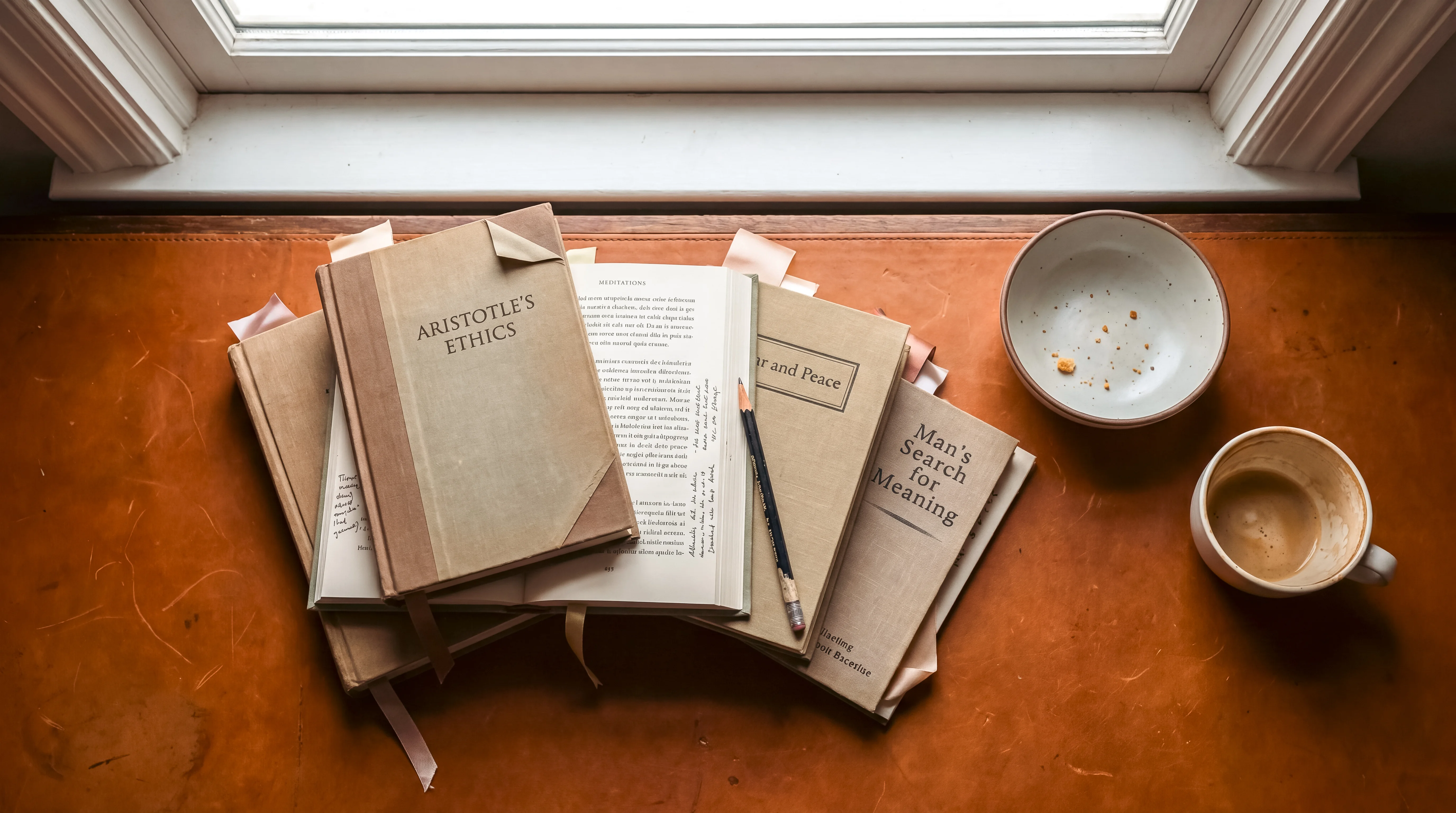
If you have made it this far looking for the best books to find your purpose, it is worth starting by making something clear: there is no book that will give you your purpose. I'm sorry. If it were that easy, you would have already found it, and so would the two hundred million people in the world who ask themselves the very same question.
What does exist are books that train you to look for it well. That give you the vocabulary to name what you feel. That confront you with questions you had been avoiding. That teach you to read reality —including your own— without the distortions of the feed. That pair you with interlocutors who died two thousand years ago but remain more intelligent than most contemporary podcasts.
Those books indeed change lives. But there is a nuance that the philosopher José María Torralba captures very well in his book A Liberal Education: these books do not function as manuals. They function as interlocutors. That is to say, it is not about reading them to extract key points and apply them. It is about reading them slowly, letting them ask you questions, and letting your life respond to those questions over the course of years. The difference between a reader and a consumer of books is exactly that.
That is why this is not a typical blog list. It is not a ranking. It does not promise clarity. It is not going to "give you the keys" to find your purpose in 15 minutes.
What it does do is select ten books —five classics and five contemporaries— which, held over time, do a deeper work on your vocational question than any coach, course, or test. I will explain why each one is here, what it will do to you, and how to approach it.
How this selection was made
Before the list, two minutes on the criteria. To enter this list, a book had to meet four conditions.
One: be demanding, not comforting. There is an entire genre of books that tell you what you want to hear. They are not here. What is sought in this reading is for something to make you uncomfortable, not for something to confirm you.
Two: withstand rereading. A book that is only read once is not made to accompany you. The ones on this list can be read again at 25, 35, and 50, and tell you different things each time. That is the test.
Three: that the author has lived what they write. This rules out most coaching literature. Aristotle, Marcus Aurelius, Frankl, Tolstoy, Torralba — they all write from within the question, not from the outside selling answers.
Four: that it opens doors, rather than closing them. A good book on purpose leaves you with more curiosity than you had. It pushes you to the next book, the next conversation, the next experience. Those that close the question —"ten steps to find your passion"— are of no use.
With that out of the way, let's get to the books. The psychologist and authority on self-knowledge Claudia Arrieta summarizes it well when she insists on something central: purpose is not found; it is built, over years of reading, looking, and choosing. This list is the building material.
Category 1: To learn how to ask yourself the questions
1. Nicomachean Ethics — Aristotle
It had to be first. Twenty-four centuries later, it remains the best manual on purpose ever written. Aristotle starts from a brutal observation: everyone claims to want to be happy, but almost no one has defined what happiness is. And he dedicates the book to doing so, slowly, chapter by chapter. His thesis, simplified: a fulfilled life is one in which you unfold your own virtues in a real community, over time, with good friendships.
It is neither motivational nor mystical. It is practical. Read books I, II, and X first —they are the ones that will have the most impact on you— and save the others for the second reading. I recommend the Alianza edition (translated by Pallí Bonet). It will force you to ask yourself something that no test answers: what kind of person do you want to become.
2. Meditations — Marcus Aurelius
The private journal of the most powerful emperor of his time. Marcus Aurelius wrote this for himself, never thinking anyone would read it. That is why it is uneven, repetitive, and, at its best moments, breathtaking. It functions as a manual for daily self-repair: how to get up every morning when you don't want to, how not to lose your sense of direction amidst the noise, how to take seriously what you have to do today.
It is the perfect book to read in small doses: two pages in the morning, over months. Recommended edition: Gredos or the one by José Manuel Mora in Alianza. It is one of those books that is never finished; it accompanies you.
Category 2: To look at reality without filters
3. Man's Search for Meaning — Viktor Frankl
Frankl, a Viennese psychiatrist, survived Auschwitz and, after getting out, wrote this book in nine days. His fundamental thesis, based on what he saw: what sustains a human being in the worst imaginable scenario is not pleasure or power, but meaning. Those who had a "why" survived. Those who did not, sank.
It is not light reading, but neither is it depressing. It is one of the most honest descriptions in existence of what vital meaning really is and how it is constructed in adversity. It is short, so there is no excuse. If you are only going to read one book from this list, let it be this one. Herder edition, translated by Christine Kopplhuber.
4. Anna Karenina — Leo Tolstoy
Here literature enters, and it enters through the front door. Anna Karenina is not a book "about purpose." It is the best description ever written of how several different people live their life searches simultaneously, and why some end well and others badly. Anna pursues an idea of love that destroys her. Levin pursues an idea of a good life that finds him. And between them, dozens of secondary characters who illustrate what happens when someone indeed knows where they are going and what happens when they do not.
Legend has it that Nabokov maintained it was the best novel ever written. He was probably right. Read it slowly —it has a thousand pages— and you will see patterns of your own life reflected in at least three characters. Recommended edition: translation by Víctor Gallego in Alba.
Category 3: To train the attention and the soul
5. Confessions — Saint Augustine
Probably the first modern autobiography ever written and, even today, one of the most radical. Augustine recounts how he spent thirty years looking for his purpose in the wrong places —in academic success, in passionate love, in the philosophical fashions of his era— and how he finally found himself by looking inward. The most frequently quoted phrase ("Late have I loved you, beauty so ancient and so new, late have I loved you") summarizes the entire book: the feeling of having been looking outside for what had been inside all along.
You do not have to be a believer to be impacted by it. It is, above all, a book about interiority as unexplored territory. Books I to X are the autobiographical ones; the following are more philosophical and can be skipped on the first reading. Alianza edition, translated by Pedro Rodríguez de Santidrián.
6. A Liberal Education — José María Torralba
Published in 2022, this book by Torralba —a professor at the University of Navarra— defends a thesis that has become uncomfortable in the era of professionalizing master's degrees: the most useful education for your life is not the most practical one, but the one that shapes you as a person. And for that, you need to read the great authors, not consume productivity content.
Torralba writes with a clarity uncommon in academics. He neither idealizes the past nor demonizes the present. He simply argues, with concrete cases, why a humanities graduate tends to have a more fulfilling life —and often a professionally more interesting one— than a graduate prematurely specialized in a technical field. It is probably the best book written in Spanish in the last five years on why reading matters for finding your purpose.
If you are only going to read one contemporary book on why the other books on this list matter, let it be this one. It functions as a gateway to the rest. You can find it at Encuentro, its original publisher.
Category 4: To make a move in the concrete
7. Range — David Epstein
Subtitle: Why Generalists Triumph in a Specialized World. Epstein, a journalist, dedicates the book to dismantling one of the most deep-seated myths of the Malcolm Gladwell era: that of the 10,000 hours and early specialization. He documents, with dozens of cases, that professionals with the most successful lives tend to have had lateral, non-linear paths, and to have accumulated diverse experiences before choosing their focus.
It is a particularly useful book if you are 25-35 years old and feel that you are "late" because you have not specialized enough. It will lift a weight off your shoulders. And it will give you permission to keep exploring without guilt. The Spanish translation is by Conecta. There is also an excellent audiobook version to accompany commutes.
8. The Top Five Regrets of the Dying — Bronnie Ware
Ware was a palliative care nurse in Australia for years. She spoke with hundreds of people in their final weeks and began to note patterns. It turns out that people, when dying, always regret the same things. And the first on the list, by far, is: "I wish I'd had the courage to live a life true to myself, not the life others expected of me."
It is a short book, without literary pretensions, and precisely because of that, it strikes deep. Read it when you are in one of those moments where you have been postponing an important decision for weeks. It will give you the urgency you were lacking. Plataforma edition.
Category 5: To see yourself from the outside
9. The Brothers Karamazov — Fyodor Dostoevsky
When Dostoevsky finished it, he wrote to a friend: "this is the last thing I will say, after this I can die." Three months later, he died. It is probably the deepest novel ever written about four brothers who represent four different paths in life: the sensual, the intellectual, the spiritual, and the bastard (who is, in some way, all the others).
What the book does to you, without warning, is measure yourself against those four paths. It's inevitable. And it does so with such psychological depth that when you close it, you spend weeks thinking about which of the brothers you are. "The Grand Inquisitor" —a fifty-page chapter within the book— is probably the most commented-on text in universal literature of the last century. The edition translated by Augusto Vidal in Alianza is the most recommended.
10. Walden — Henry David Thoreau
Thoreau left civilization at age 27 and went to live alone, in a cabin he built himself, by a pond in Massachusetts. He stayed there for two years. When he returned, he wrote Walden. It is not a rural manifesto or a pamphlet against modern society —although many people have read it that way—. It is the most careful description in existence of what happens to a human being when they remove the noise for long enough.
Read it not as an example to imitate —you don't have to go to a cabin—, but as a question placed before you: what of what you do every day is essential, and what is noise? Recommended edition: Errata Naturae, translation by Marcos Nava García.
How to read these books (it matters more than it seems)
If you decide to dive into this list, there are three things worth knowing about the way to read. I summarize them for you because they matter as much as the selection itself.
Do not read them in parallel. The modern temptation is to have three books started at the same time on the Kindle. It does not work with this list. These books require you to live inside them for weeks, not to visit them for five minutes a day. Choose one. Finish it. Move to the next.
Read them with a pencil. Underline. Note. Write in the margins. Return to previous pages. A book that ends exactly as it came from the press is a book that has not been read. The books on this list, when read well, end up somewhat deformed: bent covers, full margins, post-its sticking out. That is the sign of an inhabited book.
Share them with someone. As Higinio Marín used to say, "the things that one does when one puts in the due effort become something that one offers". The same goes for books. Having a person —partner, friend, mentor— with whom to discuss what you are reading multiplies the effect. Without that conversation, the book stays inside you. With that conversation, it becomes part of your way of thinking.
And, above all, do not be ashamed of reading slowly. Gregorio Luri often rescues Nietzsche, who said he considered himself a "teacher of slow reading". Read like cows chew the cud, he said. Chew twice. One and then the other. That is the discipline these books require. And exactly the one this era is losing.
What will happen if you take this seriously
I am not going to sell you on the idea that ten books are going to solve your vocational question. They are not. But if you read these ten over the next three or four years —not in three months, in years—, something very concrete is going to happen to you. You are going to have a vocabulary to name what is happening to you. You are going to have interlocutors who died centuries ago to whom you can return when you are lost. You are going to learn to distinguish between the noise reaching you and the voice that really matters. You are going to develop what Torralba calls "an ordered soul": not a perfect life, but a life with criteria.
And that, in a decade in which almost everyone is going to live reacting to algorithms they did not choose, is going to be a decisive advantage. Not just professionally. Vitally.
Where to start
If you ask me for a specific order, this is the one I would recommend to someone between 25 and 40 years old who comes fresh to this list:
Month 1-2: Frankl. It is short, it hits you hard, and it leaves you wanting more. It is the best gateway.
Month 3-5: Torralba. It will give you the framework to understand why what comes next is worth it.
Month 6-10: Marcus Aurelius in small daily doses while you read, in parallel, Range or The Top Five Regrets. The two contemporary ones are light and lend themselves to being read alongside a dense classic.
Year 2: Aristotle and Augustine. Here you enter the heavyweights. Give yourself time.
Year 3 and beyond: Tolstoy or Dostoevsky (or both), plus Thoreau. These are going to accompany you for the rest of your adult life.
It is not a rigid plan. It is an order that has worked for many people. If you deviate from it, even better: it means you have begun to have your own criteria about what you need to read.
Start with one. Whichever appeals to you most. And slow down. For the rest, you have an entire lifetime.
About Us
Discover the school
you never had.
Interesting Posts






Related Posts
What is the purpose of an MBA? Christopher Marquis, a professor at Cambridge, raised this question in The New York Times. And his answer surprised us. At TheNomba, we have contemplated the very same question since day one; in fact, it is woven into our name. Our answer? The world and businesses need individuals who are more than mere implementers. And educating them requires going far beyond management.
One day, in front of the mirror, you notice you have not had a thought of your own all day. Hadjadj and Izanami Martínez explain why it happens, and three small gestures to start breaking free.
The Greeks called the free time dedicated to oneself 'skholé.' Why August is not an escape from the year, but the threshold from which another begins.


