What to do about artificial intelligence and work: an honest guide for the next ten years
Neither is AI just another tool, nor are we all destined to become obsolete. An honest guide to repositioning your career in the face of artificial intelligence over the next ten years.

Juan Luis Velásquez
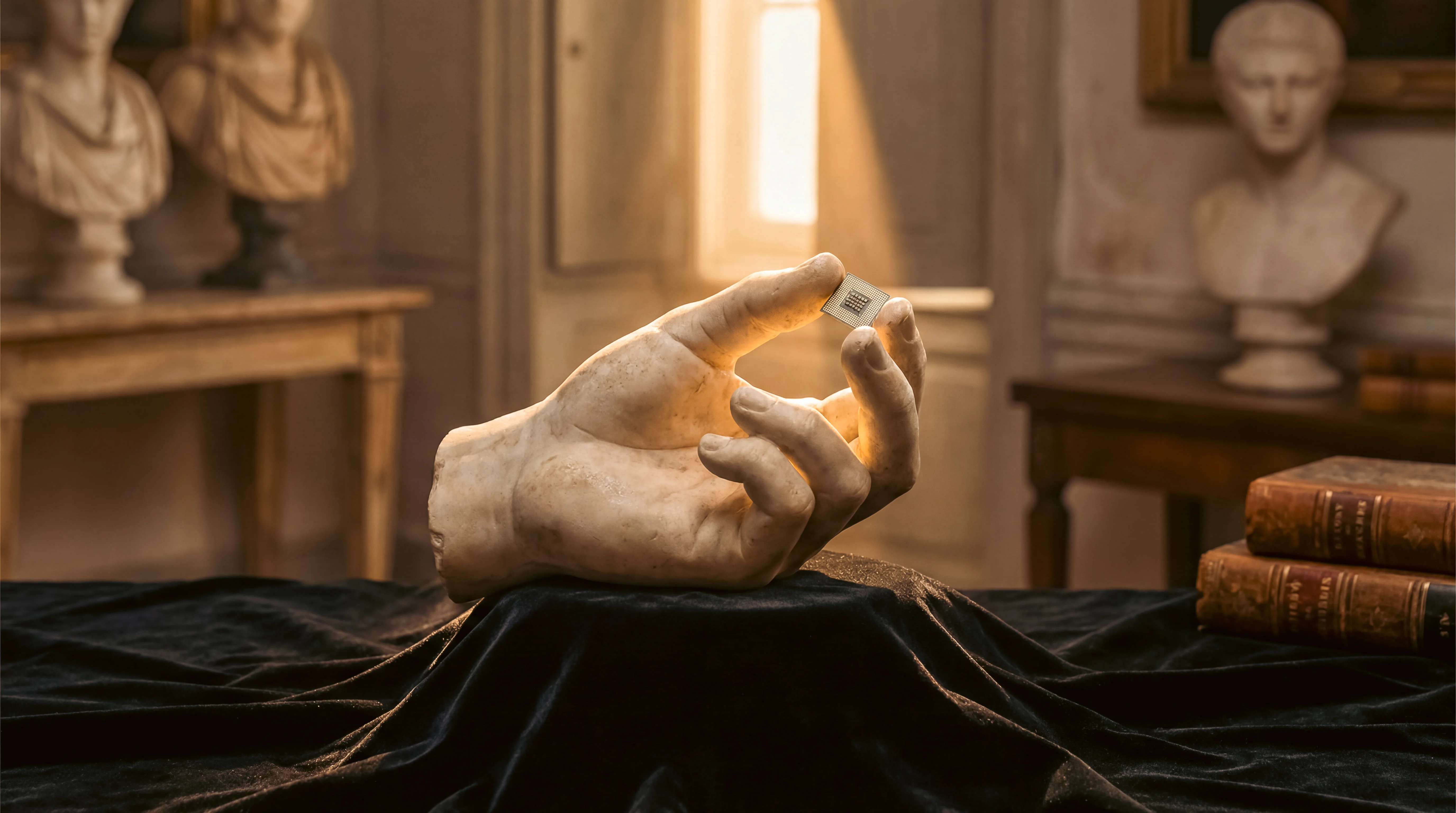
This text is intended to be, as far as possible, a serious conversation about a question that no one can postpone any longer: what do I do with my professional life in a scenario where artificial intelligence is rewriting professions at a speed that no educational system, no State, and almost no company can process?
You won't find here the heroic tale of "AI is just another tool" —which is false— nor the catastrophism of "we will all be obsolete by 2030" —which is lazy—. You will find what we know today, stated soberly, and a practical framework for making decisions without deceiving yourself.
Let's start from the beginning.
The uncomfortable truth that almost no one wants to say out loud
Javier Recuenco, who has been working in artificial intelligence for over three decades, formulates the question with painful clarity:
"When a machine does something better than we do, that automatically becomes machine territory."
This is not an opinion. It is a historical fact. Since Deep Blue beat Garry Kasparov in 1997, no human grandmaster has ever beaten a machine at chess again. It won't happen again. And yet, chess did not end. Chess is more alive than ever.
That is the first important clue. When a machine outperforms you in a task, that task is no longer yours. But that does not mean you no longer have a place. It means your place moves. And understanding where it moves is the only question worth asking seriously.
Why this change is not like previous ones
For years you have been reading the reassuring argument: "whenever there was a technological revolution, some jobs disappeared and others appeared." That is true for previous shifts. It probably isn't entirely true for this one.
When the combine harvester arrived, 30 or 40 reapers who went from town to town were left without a trade, but mechanics, manufacturers, and agricultural engineers appeared. When the steam engine arrived, the same happened. The industrial revolution caused pain but also generated huge new industries, accessible to people without higher education.
What is happening with generative AI, Recuenco says, has never been seen before:
"You are safer if you are a plumber than if you are a doctor. If you are a sewage worker than if you are a mathematician. This never happens. We have no idea what is going to happen."
For the first time in history, technological stimulus is eroding white-collar intellectual work first and leaving skilled manual labor relatively intact. This completely reorders the map of professional incentives we have inherited. For eighty years, university functioned as a guarantee against structural unemployment. That promise, in its current form, no longer holds.
This is what is worth accepting, without drama and without denial, before moving forward.
The five attractors and why this moment concentrates everything
Recuenco talks about macro-attractors: convergences of simultaneous changes —technological, social, energetic, geopolitical, cognitive— that cause a historical period to accelerate much faster than its context. The last time so many attractors coincided was the Industrial Revolution.
Today, he says, there are at least five operating at the same time. That explains the widespread feeling of vertigo, of not catching up, of Monday's news being obsolete by Friday, of three-year plans not holding up. It is not just your impression. It is the texture of the moment.
There is a law that helps a lot here. It is called Amara's Law:
"We overestimate the change that will occur in one year, but underestimate the change that will occur in ten years."
In other words: we are too catastrophic about the immediate and too naive about the medium term. We think AI is going to destroy everything next year and we fall short when imagining what work will be like in 2036. It is exactly the other way around.
That is the first operational rule for the next ten years: do not panic over monthly headlines; take the direction of the decade very seriously.
How your brain is reacting (and why it confuses you)
This is where disciplines enter that do not normally mix with management conversations. Neuroscience has something important to say.
The human brain —as researchers like Raúl Alelú-Paz explain clearly— is calibrated by a long evolutionary history. It is optimized for relatively stable environments, to reward group belonging, to punish uncertainty, and to minimize cognitive expenditure. In simple terms: your brain does not want you to change professions. It does not want you to learn something new unless it is strictly necessary. It does not want you to face the possibility that your sector is in decline.
That is why most people, when encountering the first signs that AI is affecting their sector, react in three predictable ways:
Denial. "In my field it's different, this won't reach me."
Minimization. "Yes, but it will only affect the simplest tasks."
Procrastination. "I'll worry about it when it becomes obvious."
All three responses are comfortable. All three are, in the current context, dangerous. Not because AI is coming for you tomorrow, but because every year lost in denial is a year lost in adaptation, which is the only thing that actually depends on you.
Recuenco calls it, citing a technical concept, truth coping: the ability to manage reality. And he warns of something important:
"Reality is only for adults. It is, in fact, the ultimate rite of passage to adulthood: your ability to manage reality."
Getting through this professionally well begins there. By stopping treating AI as an abstract podcast conversation and starting to treat it as a real factor that is going to define your next three or four major decisions.
The big question wrongly asked
Most professionals ask the wrong question: "Is my job going to disappear?". The correct question is different. It has three parts:
First: What specific parts of my current job will machines do better than me in the next five years? If you answer honestly —not as you would like—, that list is longer than you thought. Do not be afraid. It is information, not a sentence.
Second: What parts of my job will not be done by machines? Not because of my whim, but objectively. What kind of judgment, what kind of presence, what kind of relationship, what kind of creativity does my role require that remains difficult to automate?
Third: How do I reposition myself, this year, to focus more and more on the latter and delegate more and more of the former to machines? This is not a question for 2030. It is a question for the next twelve months.
Recuenco has a very useful image for this, inherited from Kasparov himself. When Kasparov lost to Deep Blue, he did not get angry. He proposed something new: centaur chess. Teams made up of a human plus a machine competing against other human-machine teams. And he discovered something extraordinary: the best centaur was not the best human in the world with the best machine in the world. It was a human of average skill with a decent machine and an excellent collaboration protocol.
That is probably the best metaphor we have for the next ten years of work. The question is not "me or the machine?". The question is: what centaur are you going to ride?
What the machine cannot do (yet, and probably never the same)
There is a deeper philosophical debate that now, for once, matters a great deal in practice. Thinkers like Latorre have spent years reminding us of something that technological euphoria forgets: technology is not neutral. It is an extension of the human, but it is not the human. And there are things belonging to the core of the human that cannot be outsourced to a machine without losing what is essential.
Without getting into deep philosophy, there are five capabilities that in 2026 remain clearly human. And all reasonable bets on your next working decade should involve strengthening at least two of them:
One: judgment in situations of incomplete information and serious consequences. Deciding when to fire someone, when to close a project, when to trust a partner, when not to operate on a patient. An AI can assist. Responsibility —which is what gives weight to judgment— cannot be transferred.
Two: original creativity, not of combination. AIs combine very well. They generate. They mix. What they do not do —because they have no subjective experience— is start from scratch from their own pain or wonder. That is the difference between a text well-written by a machine and a novel that changes your life.
Three: real presence. An honest conversation between two people, a class with a teacher present, a mediation between two conflicting parties, a delicate surgical operation, a funeral, a wedding. Human presence cannot be substituted. And, paradoxically, the more the rest of the world is automated, the more economic value presence will have.
Four: care. Caring for sick, elderly, vulnerable people. The society of 2036 will have an inverted demographic pyramid in much of Europe and Asia. The demand for care is going to grow faster than almost any other job category. And care relies on human touch.
Five: meaning. Accompanying someone to understand what to do with their life, leading a team with judgment, educating, training, mentoring. Everything that has to do with providing a framework for another human being's experience remains human territory.
Any professional career that over the next ten years anchors itself in one or two of these five areas, with seriousness, is going to be fine.
How to decide concretely
Let's get practical. If you have to make decisions this year, here is a simple framework in four steps.
One: audit your current work. Take a notebook. List all the tasks you do in an average week. Mark with an A those that an AI already does reasonably well. With a B those that they will do well in three years. With a C those that they probably won't do even in ten. If the sum of A and B exceeds 60% of your time, you need to make a move. Not out of fear. Out of strategy.
Two: invest 10% of your time in learning to use AI as an ally. Not as a threat. As a tool. The professionals who will be best off in 2030 will not be those who know their field best. They will be those who best integrate their trade with AI. The centaur beats the human alone and the machine alone. But you have to learn to ride it.
Three: consciously reinforce one of the five human zones. If you work in marketing, pour yourself into strategy and original creativity, not operational production. If you are a lawyer, specialize in judgment and mediation, not contract drafting. If you are a teacher, double down on presence and mentorship, not syllabus delivery. If you are a doctor, reinforce the relationship with the patient, because that is where the difference lies.
Four: accept reality. You are going to change jobs more times than you expected. You are going to learn things you don't want to learn. You are going to make a wrong bet or two. That is not failure, it is the cost of operating in a highly uncertain environment. Loss aversion —says Recuenco— is one of the worst cognitive biases we have. It makes you hold onto what is no longer useful for fear of losing it. Deciding well at this moment requires losing things on purpose.
The human era
There is a conclusion that almost no one is willing to say and that matters to be written.
Paradoxically, AI is going to make what is specifically human more visible than ever. When the accumulation of information, analysis, writing, routine programming, and a thousand other tasks are done better by a machine, the only thing left as a human advantage will be to be very human. With judgment, with presence, with real creativity, with care, with the ability to provide meaning.
The next ten years are not going to be, as many predict, the era of the end of human work. They are going to be, if we do it right, the human era in its most demanding sense: one in which only what is profoundly human will be irreplaceable.
The question is not whether you have a place in that world. You do. The question is whether you are going to earn it through hard work or if you are going to sit around waiting for it to arrive on its own.
Spoiler: it doesn't arrive on its own.
About Us
Discover the school
you never had.
Interesting Posts






Related Posts
What is the purpose of an MBA? Christopher Marquis, a professor at Cambridge, raised this question in The New York Times. And his answer surprised us. At TheNomba, we have contemplated the very same question since day one; in fact, it is woven into our name. Our answer? The world and businesses need individuals who are more than mere implementers. And educating them requires going far beyond management.
One day, in front of the mirror, you notice you have not had a thought of your own all day. Hadjadj and Izanami Martínez explain why it happens, and three small gestures to start breaking free.
The Greeks called the free time dedicated to oneself 'skholé.' Why August is not an escape from the year, but the threshold from which another begins.


