Reliable vocational testing: why none are entirely so
You search Google for a 'reliable vocational test' and thousands appear. None of them are entirely so. What does exist is something better: a 25-century-old tradition of asking your same questions.

Gabriel Serrano
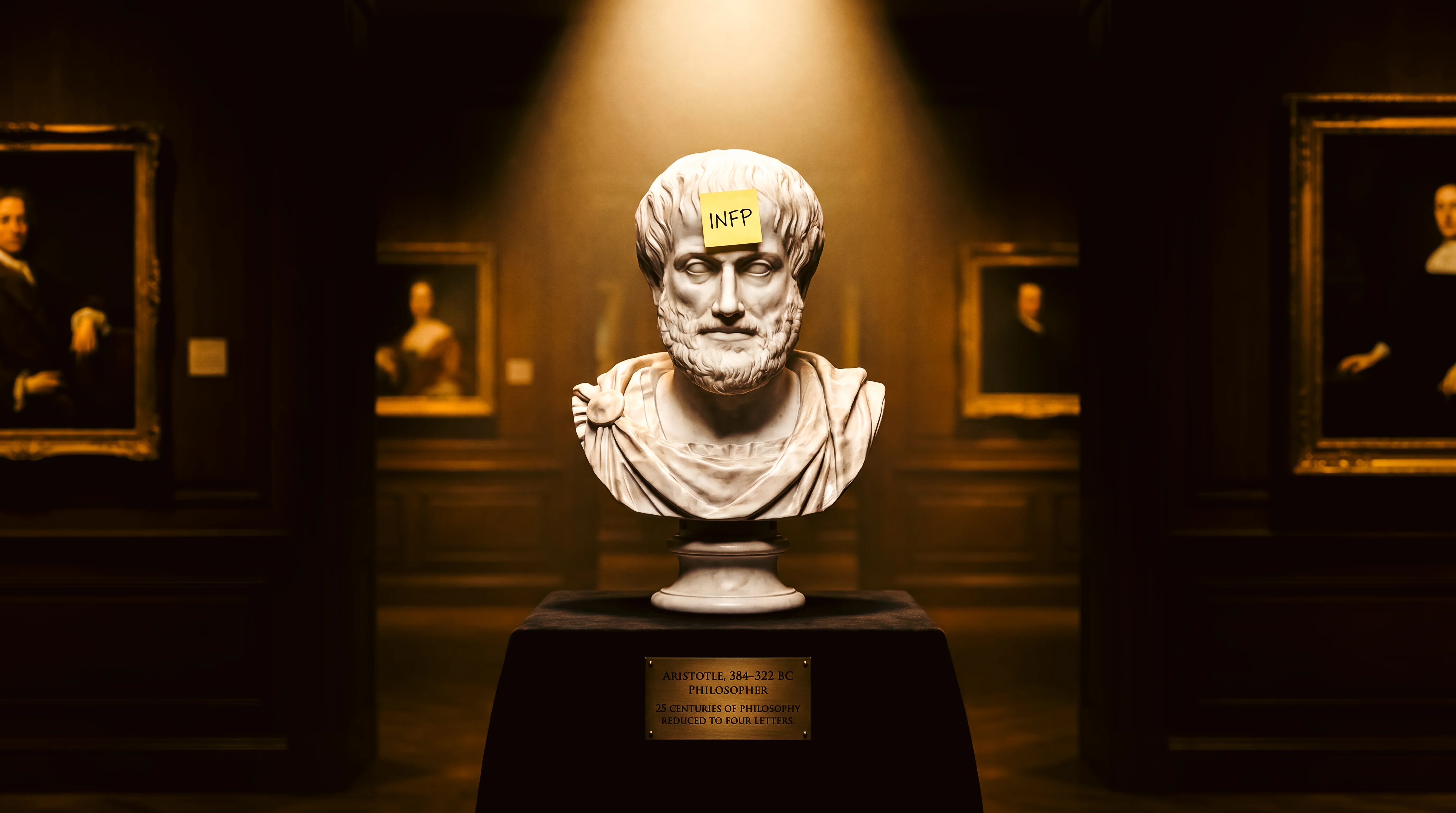
Type it into Google: "reliable vocational test". You are going to find thousands of results. The one from the public university. The consulting firm that promises clarity in 12 minutes. The 16 personality types. The Enneagram. The Big Five. The DISC. The "what career to study" based on your favorite colors. Some cost zero euros. Others, two hundred. All promise the same thing: an answer.
And here is the bad news: no vocational test is entirely reliable. And those that seem to be, are so for reasons other than what you think.
Before you close this tab with a sigh, wait. The good news is that something like a reliable tool to bring you closer to your vocation does exist. Only it doesn't look like what you're imagining. And you won't find it by filling out 80 questions on a website.
What does "reliable" mean?
In statistics, a test is reliable if it consistently measures what it claims to measure. Under that technical criterion, several are reasonably reliable. The Big Five has decades of scientific validation. The MBTI has questioned reliability, but literature exists.
The problem is that you are not looking for "statistical reliability". You are looking for a questionnaire to tell you who you are and what you should dedicate your life to. And no test in the world measures that. Not because psychometrics is bad, but because vocation is not a variable.
As Gregorio Luri used to say: "The criterion is always under construction. Always. You will never be able to say: I already have the formula of the truth of the world". It is worth double when what you are trying to know is yourself.
Your vocation is not a hidden piece of data inside you waiting for the right test to extract it. It is something that is discovered by doing, failing, conversing, reading, encountering reality, and resisting it. It is a process, not a diagnosis.
When a test tells you "you are an ENTJ, strategic leadership belongs to you," what it does is give you a label. And labels have a very specific effect: they make you feel like that's it, that the question is closed. That is where the problem begins.
Why tests are addictive (and that should give you a clue)
There is a reason why these tests go viral on TikTok and LinkedIn every few months. It is not because they work. It is because they soothe.
We live in a dizzying era. AI is reshaping entire professions. You are 23, or 27, and you have the feeling that everyone else has an advantage. Facing that, a test that tells you "don't worry, you are an INFP, your path is creativity with social meaning" lowers your heart rate. That is why they are addictive: not because they are accurate, but because they are comforting. But comfort is not truth. And confusing one with the other can cost you years.
What a test can do
I do not want to be unfair. Well used, tests are useful. But we must understand what they do and what they do not do.
A well-made test works as a mirror, not as an oracle. It reflects back to you patterns you had been seeing but had not named: "you tend to make decisions based on analysis rather than emotion." And you think: wow, that is true. That opens up a conversation with yourself. That conversation is what is valuable, not the result.
It also works as a pretext. It forces you to stop for twenty minutes and think about yourself. In a life of 16 connected hours, stopping to think is almost revolutionary.
What a test cannot do is make decisions for you. It cannot tell you if you will be happy doing what the algorithm says. It cannot substitute what is only learned by living: making mistakes, picking yourself up, and starting over.
That is why the right question is not "which is the reliable vocational test?". The right question is "what tools do I have to build, over time, an honest knowledge of myself and the world, allowing me to gradually refine where I fit in?".
And here, things change. Because there are serious answers to that question. It is just that they have been published for twenty-five centuries.
The test you have been using without knowing it: philosophy
Philosopher Enric Gel insists on an idea that seems to belong to another era, and for that very reason is revolutionary today: philosophy is not a subject, it is a toolkit for thinking about your life. It was not invented in a university department. It was invented by people who had exactly your same questions, in very different circumstances, twenty-four hundred years ago. And we have not stopped since.
Do you want a "reliable vocational test"? Read Aristotle speaking about eudaimonia. It forces you to ask yourself not what you want to have, but what kind of person you want to become. Do you want clarity on the meaning of work? Read the Stoics: Seneca, Epictetus. They will remind you that what you control is your judgment of things, not the things themselves. Do you feel vertigo rather than satisfaction? Read Kierkegaard on anxiety. That vertigo is not a failure; it is the sign that you are free. Does hacking your life and optimizing yourself seduce you? Read Nietzsche on the last man. Does not knowing which decision is right paralyze you? Read Thomas Aquinas on prudence, the art of making good decisions with incomplete information.
Each of these thinkers is a more reliable vocational test than any questionnaire, because they do not give you a closed answer: they train you to think. And thinking better is the only realistic way to keep refining, year by year, what you want to do with your life.
The idea from Luri that matters: we are in the middle
There is an image from Luri that has little of the life coach and much of classical philosophy. He speaks of the word mediocre. And he rescues it. Mediocre, he says, comes from the Latin medius ocris: the climber who is in the middle of a mountain. Not at the bottom, not at the top. In the middle.
That, he says, is the human condition. "To go down to the valley, you simply have to let yourself be carried by gravity. Inertia itself takes you down. Or you can keep going up, where the path will get rougher and rougher, you will sweat more, maybe you will lack water". Real freedom consists of just that: being able to go up or down. "There is no freedom without the possibility of worsening". You are the only being that can degrade itself. And that, paradoxically, is your dignity.
What does that have to do with a vocational test? Everything. Because the vocational question well-asked is not "what am I?", but "where am I going?". Your vocation is not a fixed label. It is the direction of your trajectory. Luri calls it moral dignity: "What have you been doing with your life? Spinning around a tree? Have you ascended? Have you descended? Where are you? What is your trajectory?".
No test can answer that for you. Only you, looking back every so often with honesty, can see if you have gone up or down. And only you, looking forward, can decide which stretch you want to climb next.
So, is there anything like a "reliable test"?
Yes. But not in the sense that Google understands it. What there are are three practices that, combined over time, do a job a thousand times more refined than any questionnaire.
One: read those who have already asked themselves your questions. If you do not know where to start, write down a handful of philosophers and read one every couple of months. Not academically. Underlining what resonates with you. Debating with them in writing. You will see that while Aristotle enlightens you, Schopenhauer makes you uncomfortable. That discomfort is also highly valuable information about yourself.
Two: converse with people older than you who have lived through things. Not with coaches who charge by the minute. With uncles, grandparents, retired teachers, friends of your parents, master craftsmen who have been doing the same thing for decades. Ask them about their crossroads. About what they would do differently. About what they discovered too late. That conversation is the only psychometrics that ages well.
Three: try things and pay attention to what happens inside you. Not to "how good it looks on LinkedIn" nor "what my parents would say." To what happens inside you. When does time fly? When do you find yourself speaking enthusiastically without meaning to? What problems of the world do you keep taking to bed? That is your authentic psychometrics. And it is only administered by living.
A friendly exception: the Nomba quiz
After all this, it would be strange to end this text by recommending a test, right? Well, we are going to make an exception, with the nuance it deserves.
At TheNomba, we have prepared a quiz that is not called a "reliable vocational test". It is called What philosopher do you have inside?. And the nuance is not cosmetic; it is essential.
It is not going to tell you what career to study. It is not going to label you as an ENTJ. It is not going to promise you clarity in 12 minutes. What it will do is this: based on how you answer a handful of real questions (about meaning, about pain, about success, about truth), it will pair you with a philosopher whose way of thinking resembles yours. Perhaps you will discover that you have a Stoic inside who has been latent for years. Or a Kierkegaard who explains why you have felt this way since you were twenty. Or an Aristotle who helps you understand why the idea of "passion" as it has been sold to you has never quite convinced you.
Is that a reliable vocational test? No. It is something much better: an invitation to read. A gateway to a tradition that has been asking your questions for twenty-five centuries, better than you will ask them on your own. If the quiz gets you to open a book by your philosopher that you wouldn't have opened otherwise, it has already done its job. The rest of the way is up to you.
And that, paradoxically, is the closest to "reliable" you are going to find.
Conclusion without oracles
Go back to the Google search we started with. "Reliable vocational test". Close the tab. And try something else: ask yourself what book you have been putting off for months. What conversation you have been avoiding. What experience will give you real information about yourself that no algorithm can provide.
The reliability you seek is not in a questionnaire. It is in a life lived with attention, read with honesty, and discussed with those who know more than you. Philosophy has been the best laboratory we have for that for centuries. And the Nomba quiz, if you want to start somewhere, is as good a door as any. But it is only that: a door.
What lies behind, you must walk through yourself.
About Us
Discover the school
you never had.
Interesting Posts






Related Posts
What is the purpose of an MBA? Christopher Marquis, a professor at Cambridge, raised this question in The New York Times. And his answer surprised us. At TheNomba, we have contemplated the very same question since day one; in fact, it is woven into our name. Our answer? The world and businesses need individuals who are more than mere implementers. And educating them requires going far beyond management.
One day, in front of the mirror, you notice you have not had a thought of your own all day. Hadjadj and Izanami Martínez explain why it happens, and three small gestures to start breaking free.
The Greeks called the free time dedicated to oneself 'skholé.' Why August is not an escape from the year, but the threshold from which another begins.


