Is it worth pursuing a master's degree in 2026? What no brochure will ever tell you
In 2026, pursuing the majority of master's degrees on the market is a poor investment. This is not only due to the financial cost, but also because of the time, the opportunity cost, and the outdated worldview with which you emerge from them.

Juan Luis Velásquez
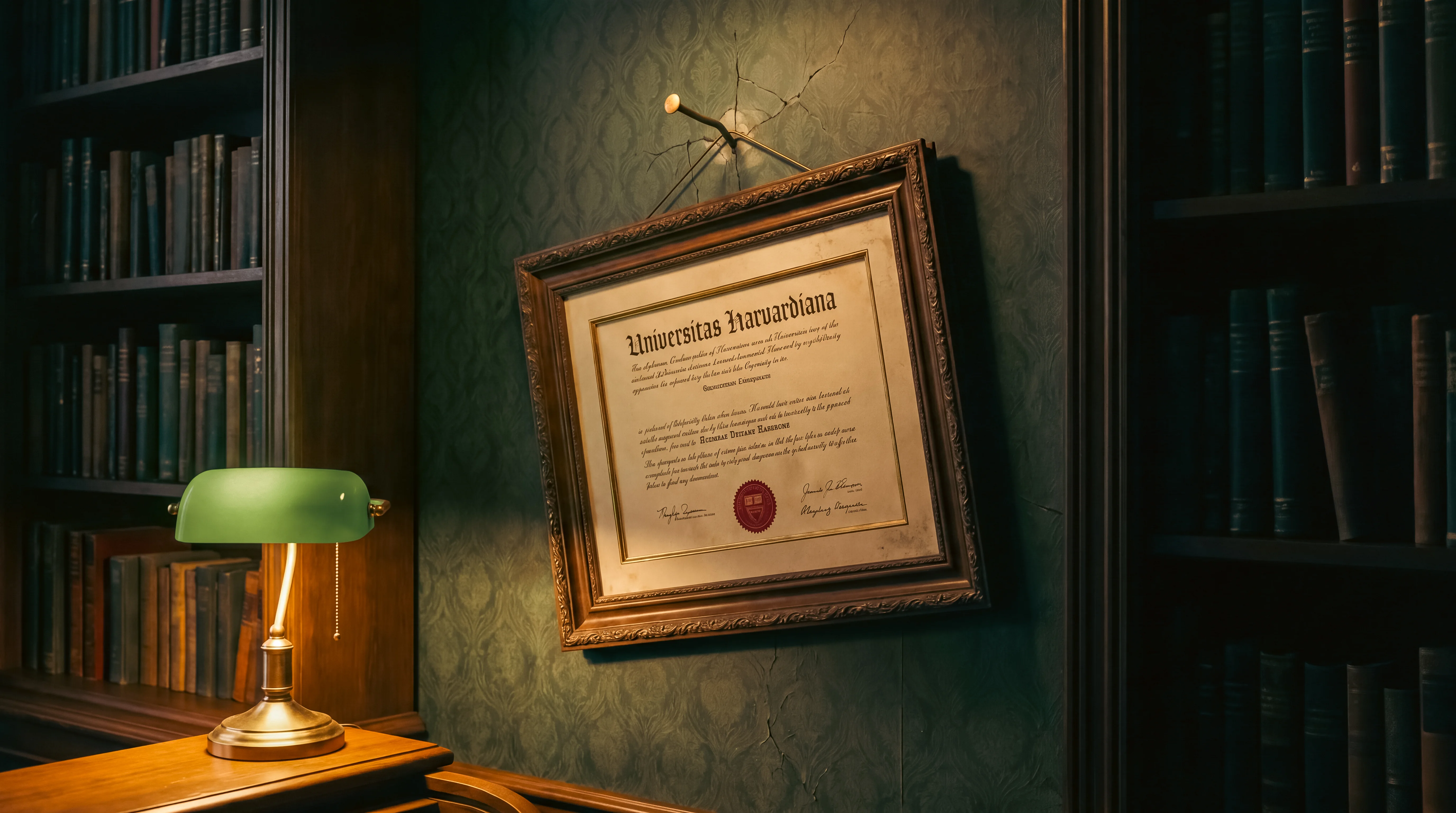
I will save you 1,500 words of suspense and get straight to the point: in 2026, pursuing most of the master's degrees on the market is a bad investment. Not just because of money, though that too. Because of time, opportunity, and, what is more serious, the image of the world you leave them with.
This is not a comfortable opinion. It probably clashes with what you are being told at home, with what people around you repeat, and with the logic you have been assuming since you were a teenager: study something "good," get good grades, do a master's, chain internships together, get promoted. But that script was designed for a world that no longer exists. And master's degrees, especially management master's degrees, are the last piece of that script that continues to charge between twenty thousand and ninety thousand euros for a promise they can no longer keep.
Let's look at this closely. Because within the category there are exceptions. And because, if you decide to do one this year, it is best that it be for the right reasons.
What a master's degree claimed to give you (and why it no longer does)
For forty years, a good master's degree gave you four things: advanced technical knowledge, a privileged network, a recognizable credential, and a shortcut to positions of greater responsibility and salary. In the stable economy of the last third of the 20th century, those four things reinforced each other.
What is happening in 2026 with each one?
Technical knowledge is no longer what it used to be. Not because the programs have gotten worse, but because the shelf life of technical knowledge has collapsed. What you are taught in the fall is partially outdated by spring. A reasonably disciplined person with good AI models, two well-chosen books, and practice gets further in six months than most full-time students.
The network of contacts still has value, but it is no longer exclusive. Online communities, specialized short programs, and industry conferences offer denser and much cheaper networks than those of a generalist master's degree.
The credential is worth whatever it is worth in the specific sector you are targeting. In investment banking or top strategic consulting, it still carries weight. In the rest—which is the vast majority—the recruiter scans your CV in twenty seconds and looks at what you have done, not what courses you have taken.
The shortcut to a salary has largely disappeared. The consulting firm that used to hire you at €36,000 post-MBA today hires fewer profiles, pays less, and replaces them sooner with automated agents. The partner track has stretched or ceased to exist. The financial calculation of a master's degree, which for decades was projected over five or six years post-graduation, today does not break even in fifteen.
If the original promise is no longer kept, the question is not whether the master's degree is good. The question is whether it still serves the purpose it claims to serve. The honest answer, in most cases, is no.
Why this educational model has ended (according to people who know it from the inside)
There is an intuition worth recovering. Gregorio Luri, who has spent decades thinking about education and observing it from the inside, repeats that the current educational system has lost its sense of pause. We are moving too fast. We have lost what he calls "slow reading." We have substituted rumination for quantity. And, he says, "I believe we are losing something more relevant: the soul of contemporary people is shrinking, precisely because we are too focused on being up-to-date and, as the latest thing is always yet to arrive, we avoid exactly that, the rumination".
He says this about general education. But it applies with particular harshness to most master's degrees. One-year programs, overloaded with subjects, constant evaluations, with no time to truly think about anything. They produce professionals with many certificates and very little judgment. Which is exactly the opposite of what the market over the next ten years is going to reward.
Luri also insists, speaking of how judgment is formed, on something decisive: "Judgment is always under construction. Always. You can never say, I already have the formula for the truth of the world". Judgment cannot be bought with a program. It is built slowly, by reading, failing, and conversing, over years. Any master's degree selling you otherwise is selling expensive smoke.
Tomás Alfaro Drake, a professor who has spent decades training executives and knows the system from its core, has argued for years that what is truly educational is not the accumulation of management models but the ability to think about the ideologies that move the world: politics, economics, history, anthropology. That is to say, everything that most management master's degrees have left out of the syllabus because they consider it "unpractical." This choice, sustained for decades, is what now leaves the average graduate of a generalist master's degree unable to read the historical moment in which they will have to work.
The very name of the TheNomba program—the no-MBA—is not marketing. It is a diagnosis. The MBA, as the dominant category for forty years, has had its period of validity. And that period has ended. Not because of the schools. Because of the exhaustion of the model.
Three direct arguments against doing a master's degree in 2026
One: the opportunity cost. A full-time master's degree takes away one (or two) years of productive life, can leave you with twenty to ninety thousand euros less (or in debt), and hands you in exchange a credential whose market power is falling. That same year and that same money invested in a personal project + serious mentoring + stays in relevant companies + sustained reading almost always leave you in a better position.
Two: the calibration risk. Master's degrees are designed to prepare students for the world in which those professors were trained. The curriculum is updated every four or five years; the world, every six months. You leave with a map that no longer corresponds to the territory. And worst of all: you leave thinking you have a map.
Three: the damage to curiosity. This, which seems minor, is the most important. Spending one or two more years in classrooms, exams, and tight deadlines, after having spent the last twenty years doing exactly that, conditions your brain to expect someone to tell it what to study and when. That is, it distances you from the only capacity that will sustain you professionally in the next decade: learning on your own whatever is needed.
The exceptions where a master's degree is worth it
It would be unfair to conclude without nuance. There are three situations in which doing a master's in 2026 still makes sense.
One: if the master's degree is a mandatory technical key for a regulated profession. Medicine, law in some countries, taxation, specific healthcare professions, very concrete engineering fields. Here there is no debate: no degree, no practice. The only thing to do is choose the most serious program you can afford and make the most of it.
Two: if you are making a radical career change and need the immersion. Transitioning from banking to biotech, from law to software engineering, from humanities to quantitative finance. The master's degree functions here as a crash landing. But make sure the program is highly technical and very specific, not a generalist MBA promising "transformation."
Three: if the master's degree is truly educational, not instrumental. A few programs do not sell employability or networking. They sell shaping the mind for one or two years, through demanding reading, serious conversations, and professors who truly think. If you find one like that, and can afford it, do it. But not for the credential. For the education.
What you do need in 2026 (whether there is a master's or not)
Four things you definitely need to have done thoroughly in the next twenty-four months.
Build judgment on the big questions of the moment. Read deeply about the monetary system, AI, demographics, real political ideologies (not the caricatures), and the history of Europe. Without this, you will live reacting to other people's headlines.
Do real things. Launch something, sell something, write something, make a mistake in something. Experience is the only resume that truly carries weight in the next ten years.
Learn to learn alone. Know how to choose books, ask good questions to AI models, converse with people who know more than you, read slowly. Once acquired, this is never lost.
Find serious interlocutors. Three or four people older than you, with real experience, willing to tell you the truth. That network, built slowly, is worth more than any alumni network of a top school.
The right question is not whether to do a master's degree
Go back to the beginning. The question "is it worth doing a master's in 2026?" is poorly framed. The right question is different: what do I need to learn, experience, and build in the next twenty-four months to be well-positioned in a decade that no longer rewards comfortable paths? If the answer includes a very specific master's degree, do it. If the answer is something else—which in most cases it is—have the courage to skip the script.
Your parents may not understand it at first. Your brother-in-law won't either. But the coming reality is not going to ask them anyway.
About Us
Discover the school
you never had.
Interesting Posts






Related Posts
What is the purpose of an MBA? Christopher Marquis, a professor at Cambridge, raised this question in The New York Times. And his answer surprised us. At TheNomba, we have contemplated the very same question since day one; in fact, it is woven into our name. Our answer? The world and businesses need individuals who are more than mere implementers. And educating them requires going far beyond management.
One day, in front of the mirror, you notice you have not had a thought of your own all day. Hadjadj and Izanami Martínez explain why it happens, and three small gestures to start breaking free.
The Greeks called the free time dedicated to oneself 'skholé.' Why August is not an escape from the year, but the threshold from which another begins.


