I do not wish to appear mysterious
Mystery is not the absence of light, but rather an excess of it. Robert Sarah, Ricardo Calleja, and the art of leaving some questions unresolved.
Rodrigo Sangrador
She looked at him again. And finally, she sighed. She did not know that after a month of tireless fatigue, awkward conversations, and long nights, the sun could shine once more. Just like the first day. Like that first flutter that makes you feel like the most (ad)mired person on the face of the Earth. From the mud grow the tallest flowers! Smile, sing. And embrace uncertainty.
There are books that leave a mark on you forever. They are like nails that catch onto the deepest and most intimate parts of oneself. They offer a new gaze, a paradigm shift, a new light, upon the world, upon reality, and upon oneself. “The Power of Silence: Against the Dictatorship of Noise”, by Robert Sarah, was one of those works for me. Since I read it, I experience silence in a completely different way. In fact, I haven't put my headphones on during the bus ride since then, something that would have been unthinkable for me years ago.
Written in collaboration with Dom Dysmas de Lassus (Prior General of the Carthusian Order), this work gathers the thesis of the Guinean cardinal: without silence, it is not possible to listen to God or shape a true spiritual identity. A conversation moderated by Nicolas Diat, a French journalist who, through his questions, guides the reader toward one of the most forgotten and essential themes of our time: silence. By the way, that is precisely what Jacques Phillipe spoke about in the Awakening.
The book covers many topics, so many that they wouldn't fit in a thousand newsletters. But there is one theme that fascinated me, and I wanted to talk to you today about the mystery. Yes, the mystery. Sarah revisits Dionysius the Areopagite’s idea that mystery is not an absence of light, but an excess of it. This idea resonated with me deeply, as I have a slight tendency to resolve everything metaphysically. Come on, raise your hand if you actually want to live in darkness. I like to live with a foundation, or at least with some certainty, and I am quite stubborn. That is why the idea that mystery is not darkness, but an excess of light, left me completely disarmed. I believed that what I couldn't understand was precisely a matter of darkness: “I don't understand it, I can't solve it, ergo it is dark,” and then a Cardinal comes and tells me no, that I am wrong. How?

This is the cover of the book I am telling you about… The background image of the Pantheon in Rome (today the Basilica of Santa Maria ad Martyres) symbolizes stepping away from the noise of the world and the light that enters in silence through the highest point.
It amused me because, as I was recalling these topics, Ricardo Calleja, in this month's live online broadcast, spoke to us about freedom as a mystery. And Calleja, following (whether consciously or unconsciously) Sarah's thesis on mystery, stated that freedom is part of the greatest mysteries of human existence. The Nomba ally distinguished between “problems,” which are complex issues with a solution, and “mysteries,” such as freedom, love, or truth. The professor concludes, therefore, that freedom is not an issue that can be resolved through analysis, but a mystery that must be lived and understood in its deep dimension. A problem is solved, while a mystery is lived.
That is why mystery disarms. Because it has no solution. You may like mystery more or less, but it is not a problem. Only that which is capable of being solved has the character of a problem. Thanks to Robert Sarah's book, I stopped seeing mystery as something negative and began to see it as something that accompanies human beings throughout life. It was like a: “Hey, take it easy, you can't solve everything and that's fine. Let mystery remain mystery.” Like a positive (realistic) and humble attitude toward the great questions for which I always tried to find a solution.
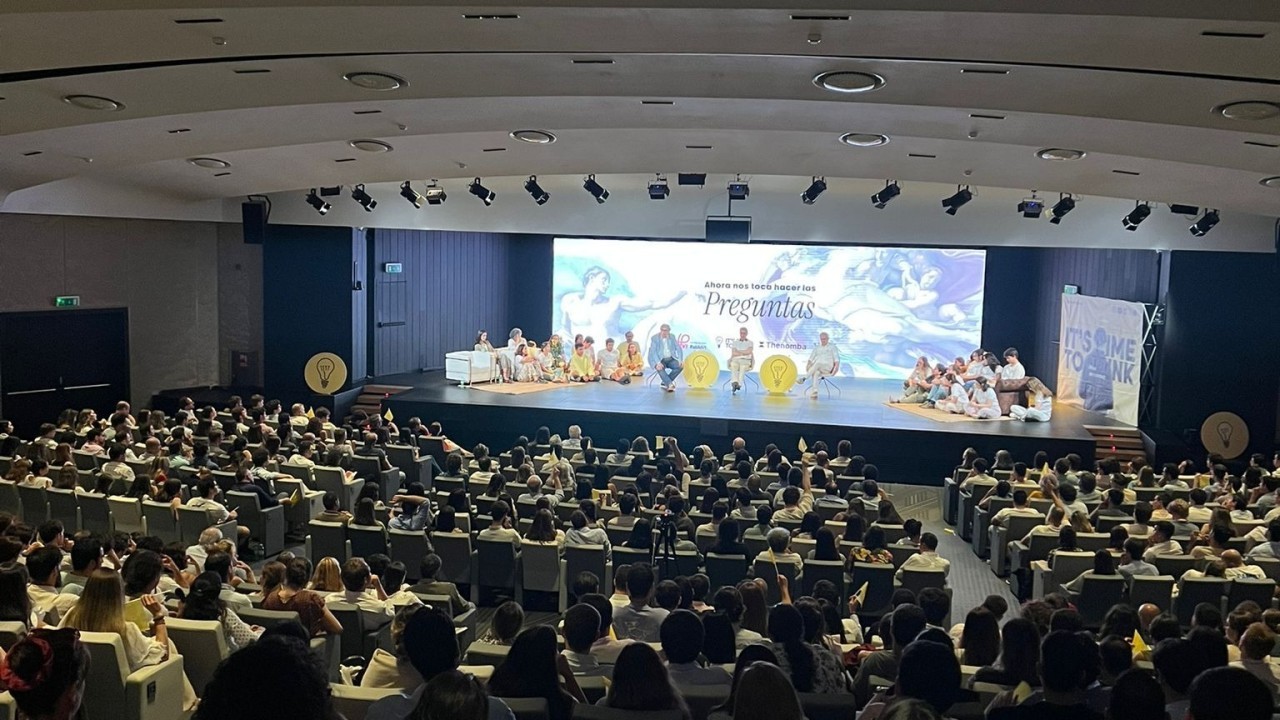
Where there was also some mystery was precisely at the Great Thinkglao of Transcendence that we celebrated at the Pablo VI Foundation in Madrid. I must confess that the most spectacular thing I have seen in a long time was the intervention of Jesús G. Maestro. Although I do not agree with him on everything, one must admit a honesty and intellectual power far from the ordinary. Thanks also to Juan Manuel de Prada and Pablo d’Ors.

Almost 1000 people stopped to think about a topic that is increasingly being talked about. A great season finale. Keep an eye out for our return in September.
This month of June, we also celebrated the Nomba meeting with José María Torralba. José María starts from a simple idea: education is not just preparing to produce more or achieve success, but caring for the kind of person one is becoming. Because, according to him, a great life is not the most recognized or the most profitable, but the one that flourishes and asks itself what it lives for and what it awakens in others. An incredible session on education, vocation, work, virtues, gratitude, reading, and greatness. It might sound very elevated to you, but with wine and cheese it sounds better, take my word for it.
And a second live online broadcast we had with Pablo Pérez, about order and law in nations. We traveled with him on a historical journey that goes from the Pax Romana to the UN, passing through the Treaty of Tordesillas, Kant, Briand-Kellogg, the Cold War, and the nuclear era… Pablo is a scholarly man and it is always a stroke of luck to be able to count on him.
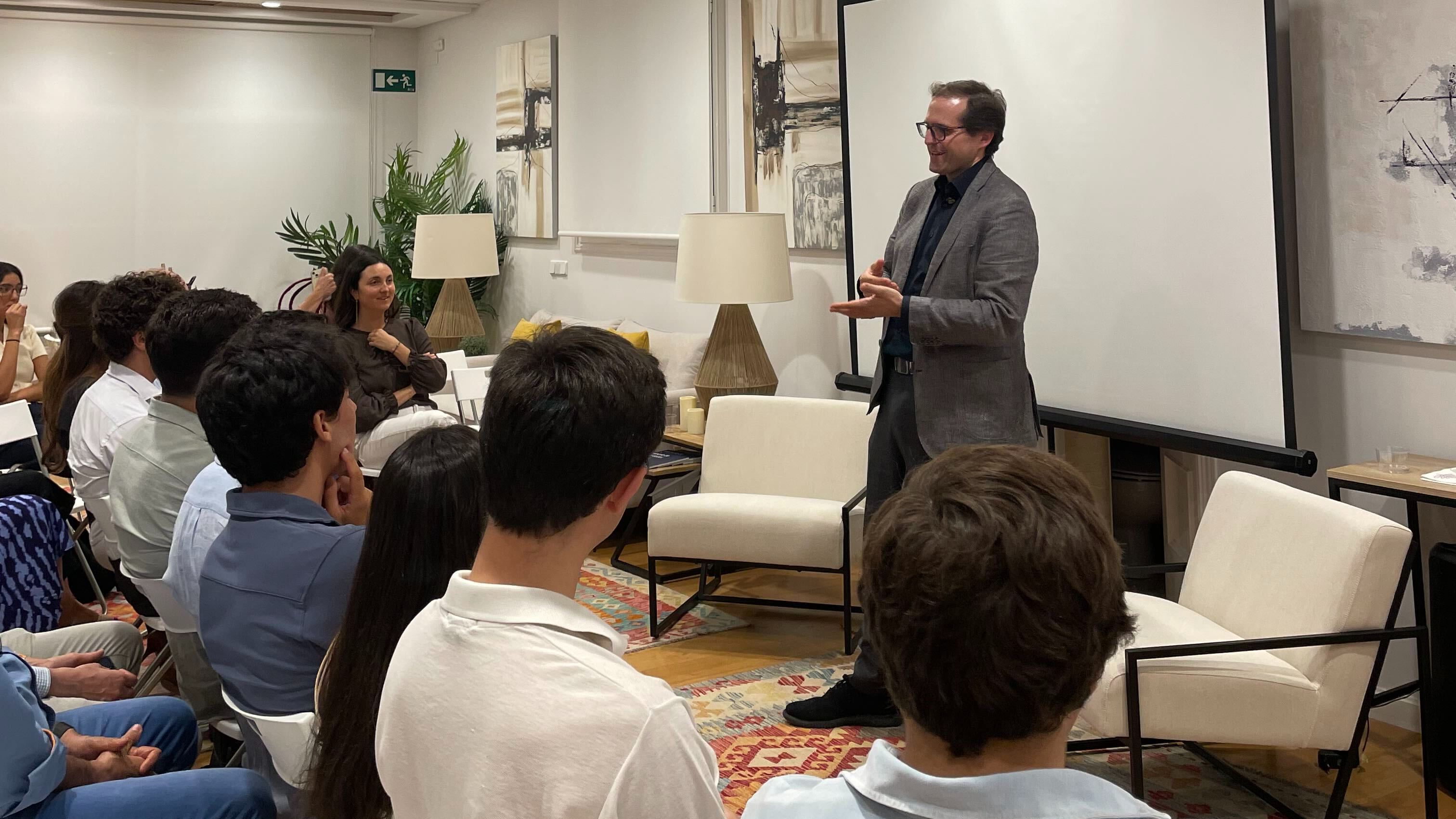
Nomba meeting with Torralba in Madrid.
We usually share something about the world here, but everything moves so fast that what happened a couple of weeks ago seems to be from another century. I don't know if you knew, but two original figures born from social networks passed away in Rio de Janeiro: Gaspi and Oliver Tree. At TheNomba we wanted to pay them a small tribute and published these reflections of theirs on the art of taking off the mask.
The World Cup has started almost without warning and the favorites are already being defined. While you ponder who will win, I leave you with what is already considered by many as the official anthem of the 2026 World Cup: Where the f*** is Curaçao?, a production by Línea de Cal and Kilgore. We know it might offend certain sensibilities. But it is good to laugh, even at oneself. And humor, oh, humor, even more than football and bread and circuses, how it helps us to lighten this heat, and our sorrows.
See you on the last Thursday of July.
Or not.
It is a mystery…
:)